

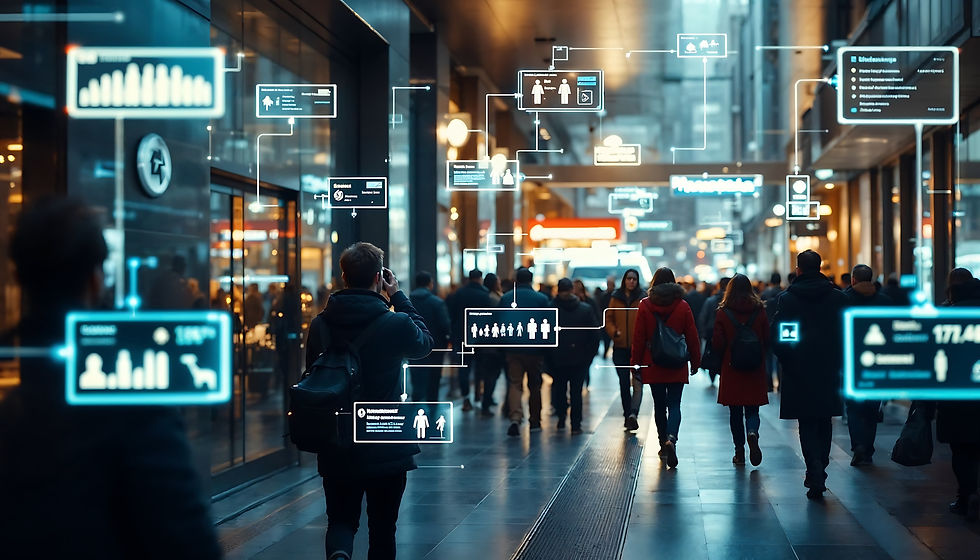
How can in-store shopper behaviour analytics help to reveal hidden sales opportunities?

Every shopper reveals valuable insights through the way they move, browse, and interact inside a store. Some head straight for a specific aisle, while others browse before making a purchase. Some products capture attention, whereas others remain unnoticed. Understanding these behavioural patterns now relies on data that shows how people interact with physical spaces. This is where retail heatmap analytics becomes a powerful tool for modern retailers. So let’s start with understanding what it exactly is.
Retail Heatmaps Analytics Explained:
It is a technology that uses AI-powered cameras, sensors, or Wi-Fi data to visually represent how customers move and interact within a physical store. It generates colour-coded heatmaps that highlight high-traffic, low-traffic, and high-engagement areas, helping retailers understand shopper behaviour and make data-driven decisions.
By tracking customer movement and dwell patterns, retail heatmap analytics supports smarter decisions that improve efficiency, engagement, and revenue.
Key Ways Retail Heatmap Analytics Improve Store Performance:
1. Understand how customers naturally move through the shop.
Knowing where visitors walk, pause, or completely avoid provides valuable insight into buying behaviour. Shopper movement tracking highlights the most frequently travelled paths and identifies areas receiving little attention.
These insights help retailers understand whether customers are following the intended journey or creating their own routes through the shop. If certain displays or departments are consistently overlooked, layout adjustments or changing SKU placement can encourage greater engagement without increasing marketing spend.
Trakomatic helps retailers convert these movement patterns into actionable intelligence, making every square metre work harder for the business.
2. Measure engagement beyond simple footfall.
High visitor numbers do not always translate into strong customer engagement. Understanding how long shoppers spend in particular areas is often far more valuable than simply counting entries.
With customer dwell time analysis, retailers can determine which displays attract visitors the most and which ones fail to capture attention; furthermore, analysing if shoppers are interacting/picking up with the products to gauge shoppers’ interest level. Longer visits near promotional zones may indicate compelling merchandising, while brief stops without interacting with the products could suggest unclear messaging or poor product presentation.
These findings allow retailers to refine in-store experiences using facts that lead to better customer satisfaction as well as sales performance.
3. Improve product visibility through smarter merchandising.
The position of products plays a significant role in purchasing decisions. Items placed in high-traffic locations naturally receive more exposure than those hidden in quieter sections. The product placement strategy varies for champion products is to drive shoppers to look for the champion products and create exposure for other SKUs.
Using product placement analytics, retailers can identify whether premium products, seasonal collections, or promotional offers are located where customers are most likely to notice them. Rather than continually introducing new promotions, retailers can maximise the value of existing inventory by ensuring products appear where customer attention is already concentrated.
4. Create layouts that encourage exploration.
An effective store design should guide shoppers comfortably through multiple zones while making navigation feel natural. Data-driven planning makes this possible.
Using store layout optimisation data, retailers can redesign pathways, reposition fixtures, and remove physical bottlenecks that interrupt the shopping experience. A smoother customer journey often results in longer visits and better exposure to additional products.
Instead of relying on gut feeling and trial and error, layout improvements become measurable business decisions that can be tested and refined over time.
5. Identify missed sales opportunities before they become costly.
Every underused section represents potential revenue that may be slipping away unnoticed. Heatmaps quickly reveal cold zones where customer activity remains consistently low.
By investigating why these spaces receive limited attention, retailers can experiment with new displays, promotional campaigns, lighting improvements, or product categories. Even small changes can significantly increase engagement when guided by reliable behavioural insights.
This proactive approach enables retailers to solve problems before they affect overall profitability.
6. Evaluate promotional campaigns with confidence.
Retail heatmap analytics enables retailers to compare customer activity before, during, and after promotional events. They can assess whether a campaign successfully attracted visitors to targeted areas or whether customers ignored the intended displays altogether.
This level of visibility enables businesses to allocate future marketing budgets wisely and strengthen campaign results over time.
7. Discover what encourages customers to stay longer.
The amount of time customers spend inside a shop often influences purchasing behaviour. Retailers therefore benefit from understanding what motivates visitors to continue browsing.
Through customer dwell time analysis, businesses can determine which displays, promotional zones, and product categories keep shoppers engaged for longer periods.
These insights help shape smarter merchandising decisions and create experiences that encourage repeat visits. Retail environments constantly evolve through seasonal collections, changing customer preferences, and new promotional activities. Retail decisions depend on current, relevant data. With retail heatmap analytics, businesses can monitor behavioural changes over time and quickly evaluate whether operational adjustments are delivering the expected outcomes.
At Trakomatic, our AI-driven analytics and accurate shopper movement tracking turn behavioural insights into smarter decisions and stronger business results.
Conclusion:
Understanding customer behaviour is no longer about observation alone. It requires accurate data that explains how shoppers interact with every part of the retail environment. From identifying high-performing displays to refining layouts and improving operational efficiency, behavioural insights empower retailers to make confident decisions that directly influence revenue and customer satisfaction.
At Trakomatic, we believe every customer interaction presents an opportunity to improve business performance. Our AI-powered analytics solutions help retailers unlock valuable insights, optimise in-store experiences, and drive measurable growth. Book a demo today.